


Is a real camera worth it for family travel photos?
My friend Rachel Lipson (yes, the renowned creator of The Point, a top 40 Substack that demystifies travel points!) asked me a camera question that yanked on my heart in a surprising way: it came from her identity as a photographer, and the pull she felt to be that person again.
What resulted is more than a camera review; it’s about what tool can bring her back to something she loved doing before she had kids! Motherhood, man. It’s a trip. We lose and gain several things along the way.
And as I wrote this, it struck a chord with me, too: my kids, my camera roll, and the minutes I’m trying to hold onto. (More on that at the end.)
OK, here’s what’s in this roll.
The sold-out camera I found in stock, six pictures I took with it, and why it’s my pick for Rachel Lipson of The Point
The split-second puppy photo from a rented Leica that made me lose my mind
Why you won’t find a camera under $1,000 here (blame the iPhone 18), plus three budget picks for you or your lucky tween
Charts! Which camera fixes low light, blurry backgrounds, and a screen you can’t see in the sun
Ana’s recommended nightly hotel travel photo routine and bags that don’t look like camera bags, so your camera and your photos stay safe
All opinions are proudly my own. In this post, I use affiliate links, which means if you make a purchase, I may get a small commission at no cost to you. Thank you for supporting Six Pics I Clicked!
Shop all the cameras mentioned in this post in one easy place!
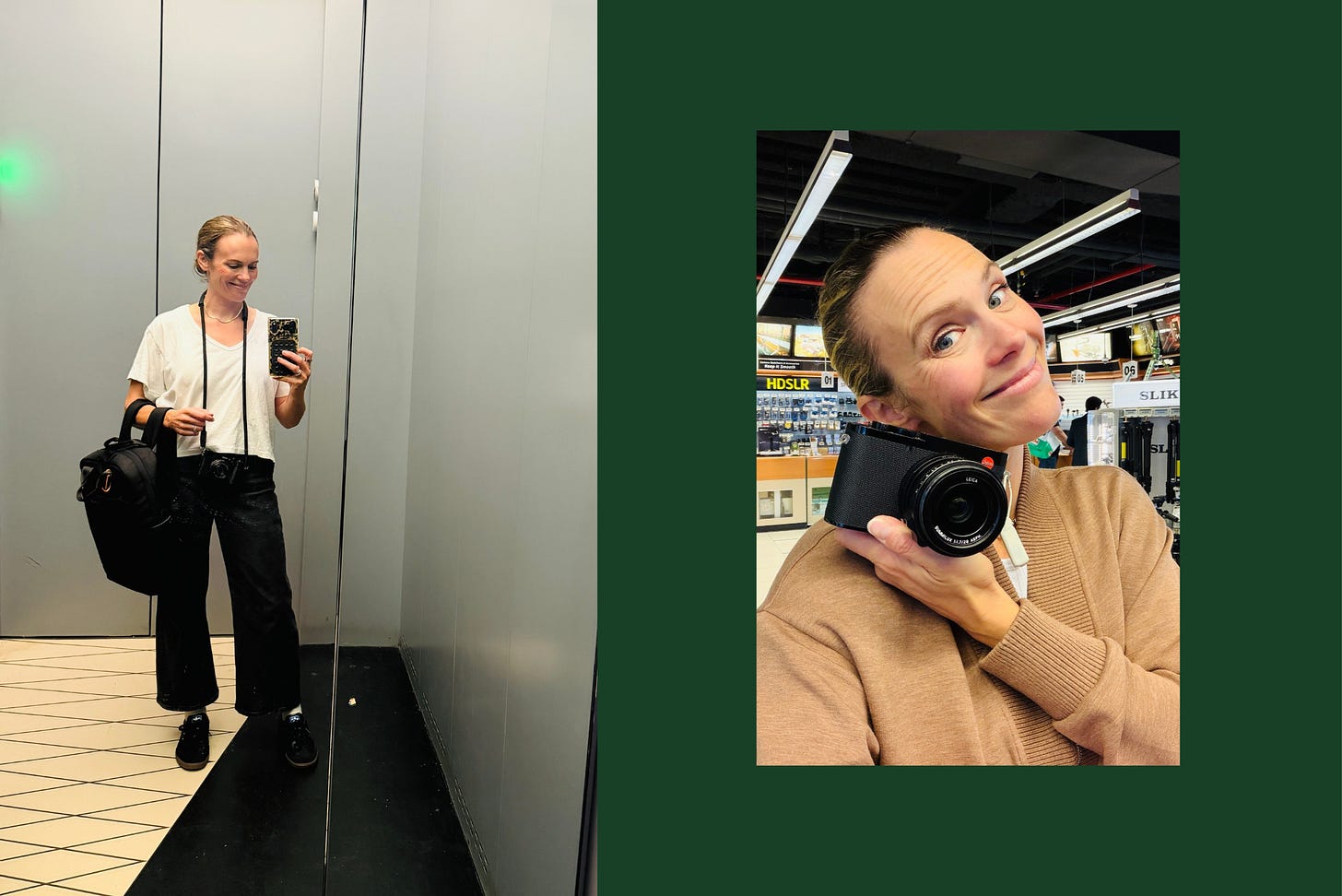
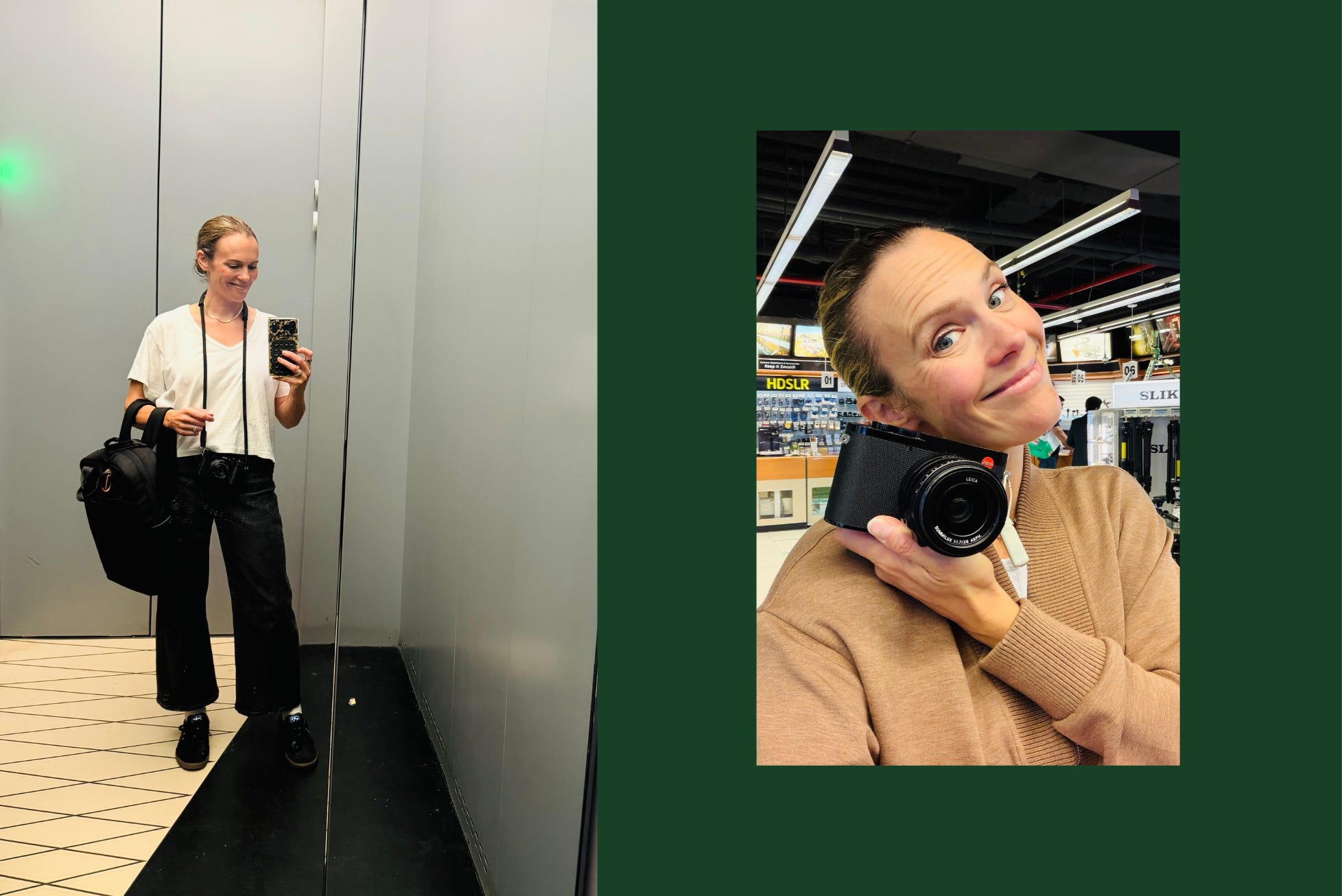
Me testing the Fujifilm X100VI at the Whitney in the Meatpacking District of NYC, me holding the Leica Q3 for the first time at B&H Photo Video.
When Rachel posed her question, we had two long convos: two millennial moms geeking out over photo histories and a love of travel. So I’m paraphrasing a bit, but here’s her essential question, and maybe it feels familiar to you:
“My family and I travel a lot. We land in a new city and get our bearings by walking around and checking out museums, historical sites, restaurants, and boutiques.
I always have my iPhone in hand, and I snap a picture when I see something I like. But often, the shot I envision in my head just doesn’t come out, and it frustrates me.
I studied photography in high school and college, and that history is still in there somewhere. Now that my kids are older, could I have more satisfying memories of our travels if I got a “real” camera?”
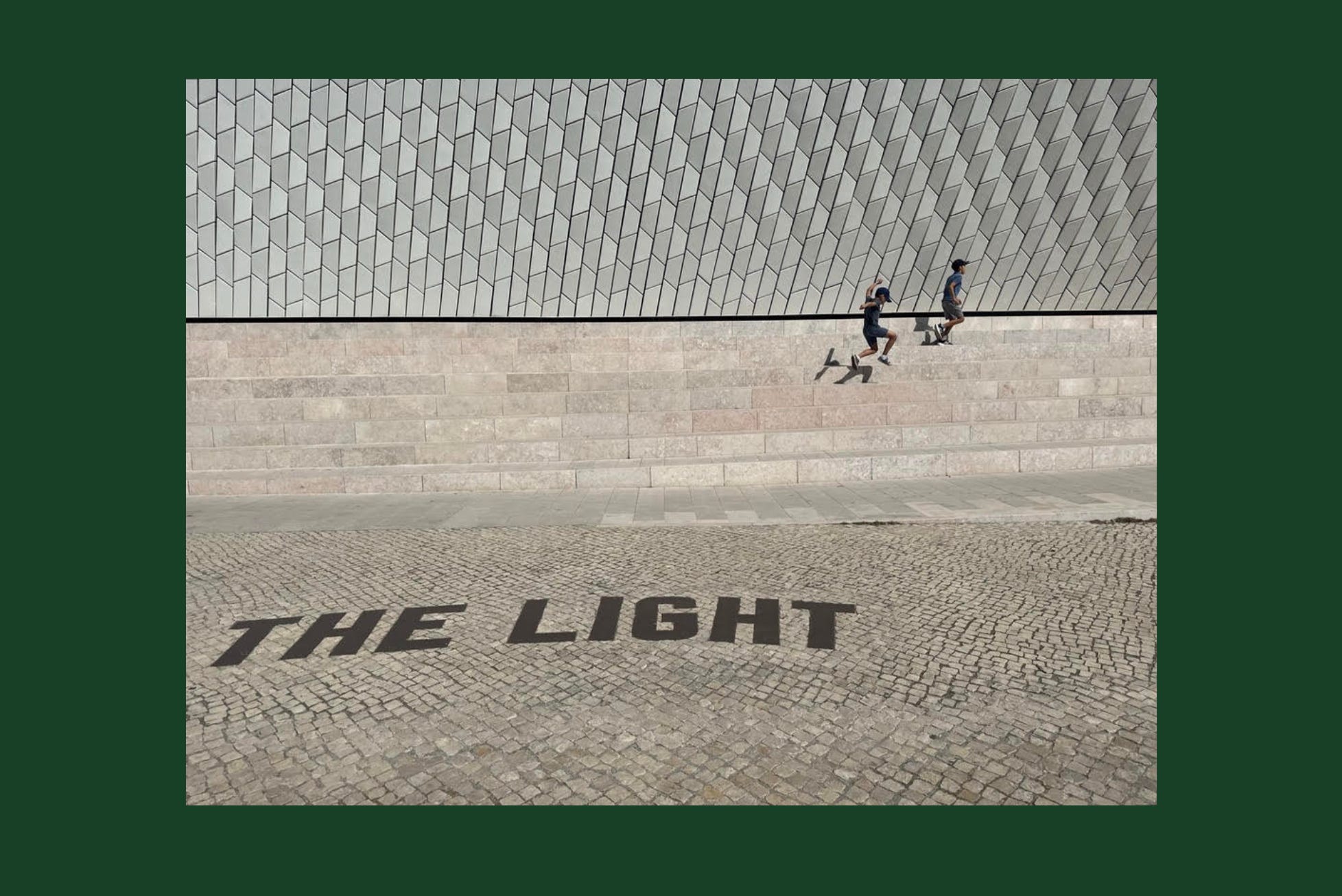
And I say… YES!
Rachel’s work is already incredibly soulful. I love the scale in the photo above, those tiny people in motion, and all the ways to interpret “THE LIGHT.” She’s wielding the iPhone very well. But there may be a tool to take her art even further. These photos are also her children’s memories, after all, and hers, too. This is worth some careful thought!
We talked through her pain points and landed on a few must-haves for her photo future. Her question genuinely spoke to me. Even though I use several cameras several times a week, I feel that same pull: I want to take an everyday moment and remember it beautifully. My iPhone is convenient, but it’s almost too frictionless to let the moment's magnitude register in the photos that result.
What iPhone photos get wrong: low light, blur and bright sun
Let’s go over Rachel’s pain points. Her pain is my pain.
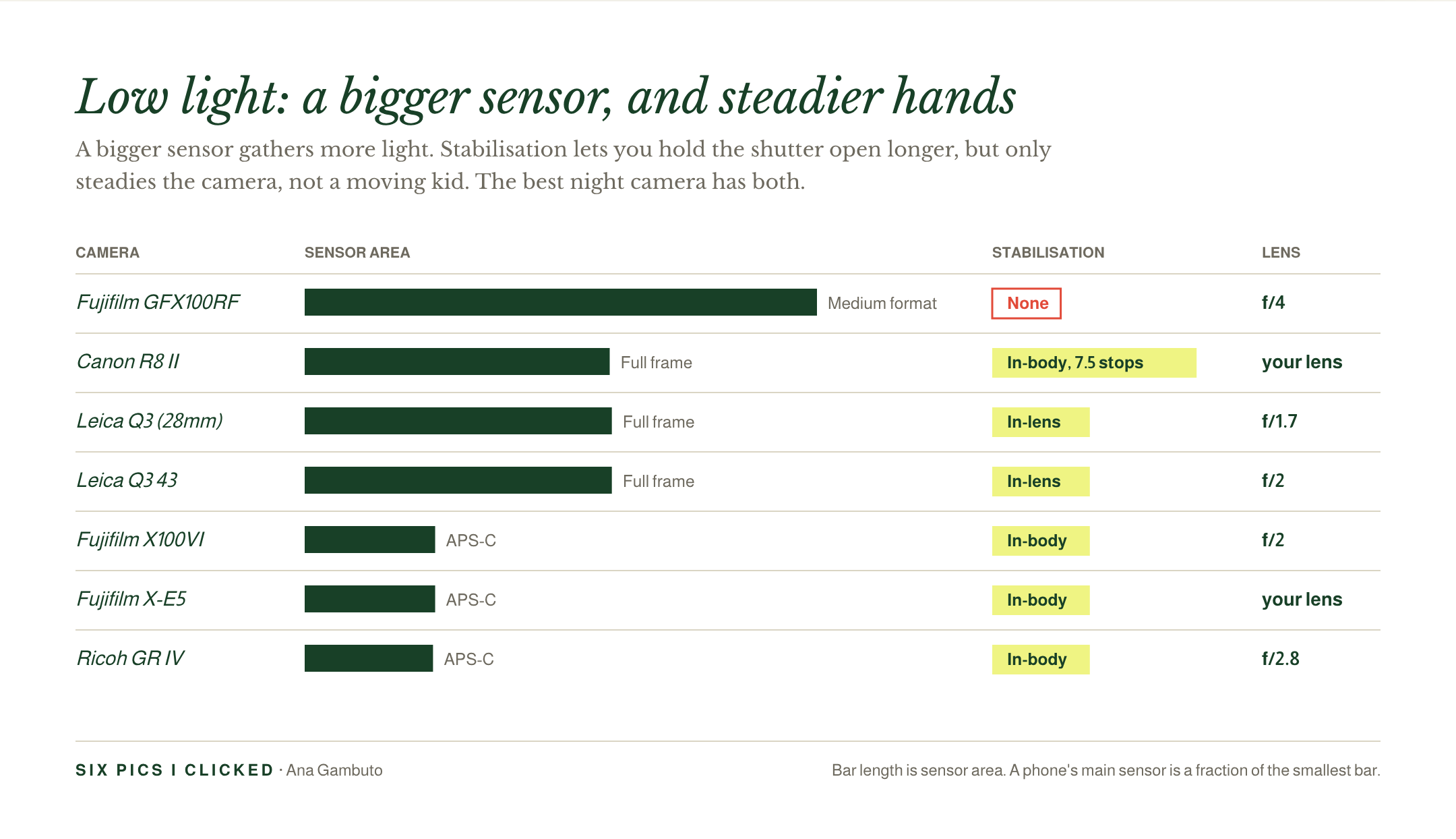
Low light. This is where a phone looks the most “digital.” Subjects are blurry, the color is weird, and the flash doesn’t look good. It’s the one that hurts a former film photographer’s heart the most, and it’s where almost every camera we’re about to talk about shines. A camera is the answer.
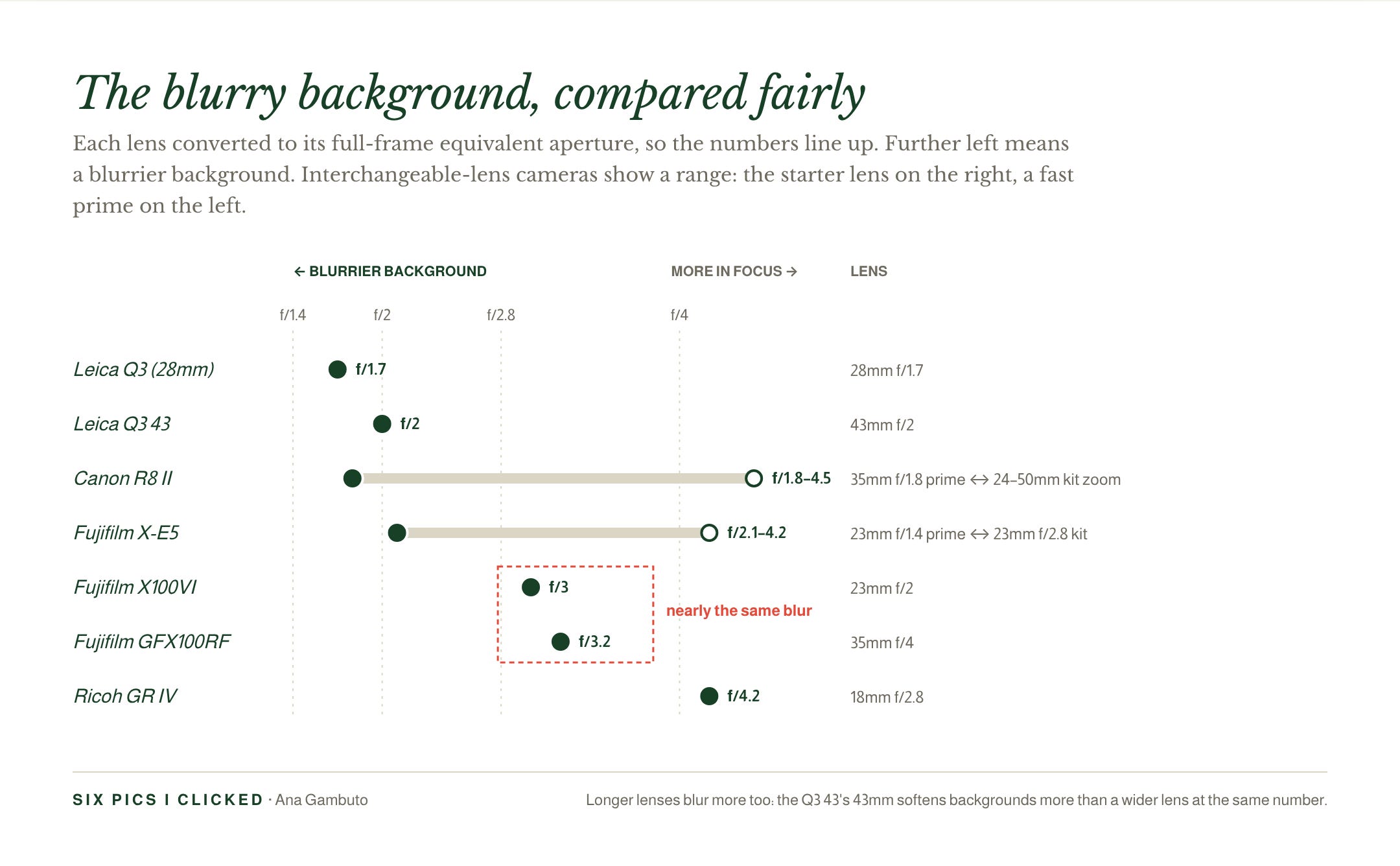
Depth of field (shallow). She’d love that beautifully blurry background that isolates your subject. The iPhone does this, yes, but it’s just… okay. Portrait mode still can’t recreate what she got from her old film camera.
A “real” camera fixes this because of how a lens is made: a fast (“fast” in camera talk means letting in tons of light), high-quality lens does in real life what a phone is faking. Faking very well, but faking.
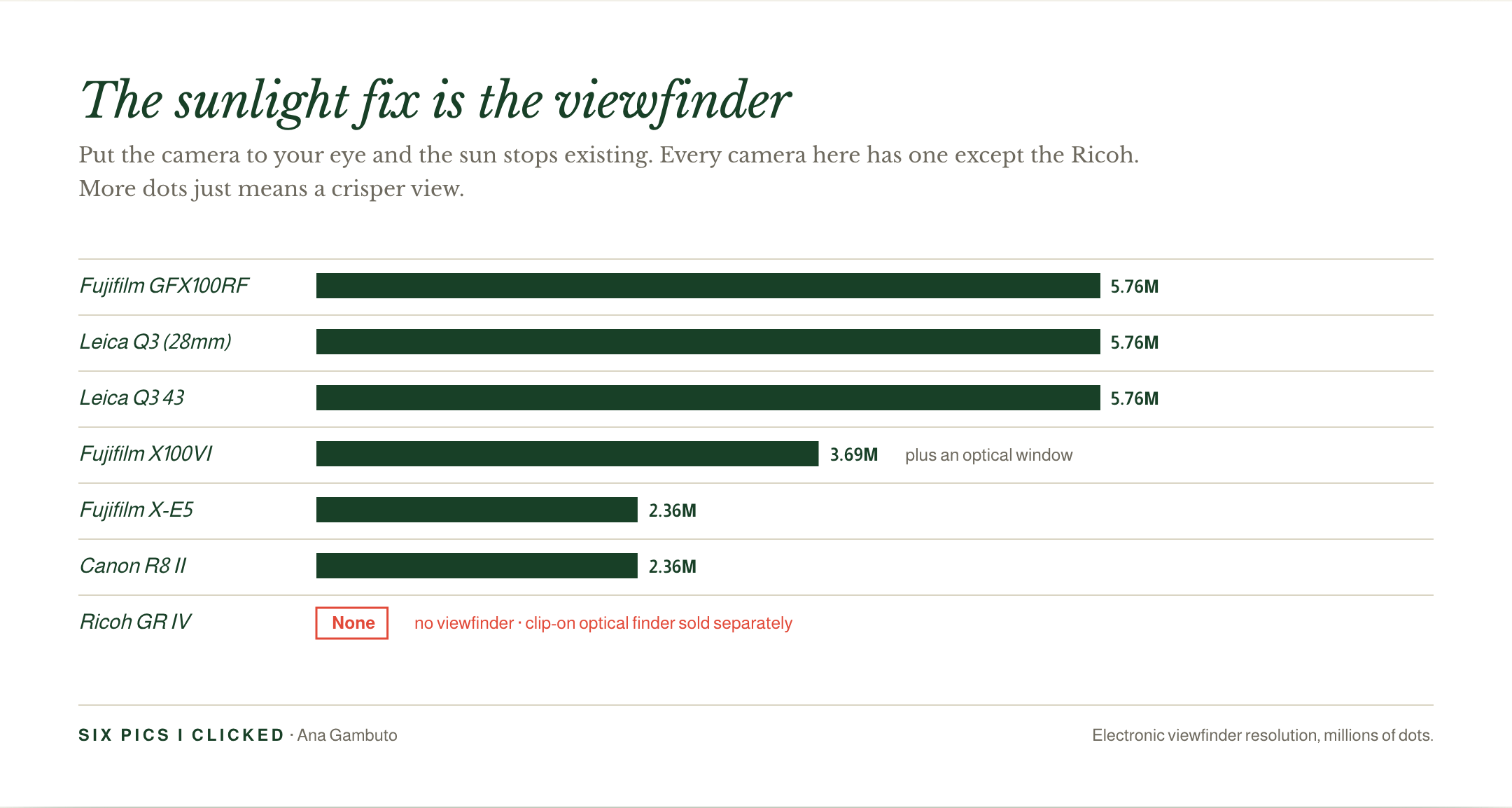
Seeing the screen in bright sunlight. It’s almost impossible on a phone, because it’s a freaking phone, and you can’t take a photo when you can’t see the screen. A camera solves this completely with its viewfinder, and almost every model here does it easily and beautifully. Phewwwww.
The shot in her head doesn’t come out. More on this one below, because it’s the big one.
What she shoots: city life. People, places, colors, textures. Her kids are tweens, and of course they don’t love having their portraits taken, but she wants to put them in the frame within a scene, in a totally casual way. And as I’ve said before, it’s a wonderfully creative constraint to take portraits without faces, for any reason. I support!

So the camera should be:
easy to use
not too heavy
not so expensive that she worries about it getting stolen
satisfying enough (good pics right away!) that she’s motivated to wake up and use it again, making the new habit stick
able to send photos to her phone, so they’re backed up if the camera’s lost
easy enough to capture and store photos that the new routine doesn’t add so much friction she never does it again
Skipping to the end
Here’s the nitty-gritty:
My pick for Rachel: the Fujifilm X100VI ($2,259). It fixes three of her four problems: low light, the shallow depth-of-field (beautiful blur) background she misses, and the screen she can’t see in the sun. And it has a built-in flash! There are a bunch of other reasons. Scroll downnnnn.
Similar pick, but with the ability to change lenses: Fujifilm X-E5 kit with 23mm f/2.8 lens: $1,899, now a few hundred cheaper than the fixed-lens version above. Quality and ease are the same as the X100VI, but it has no built-in flash.
If night photos matter most: the Canon R8 Mark II, $1,899, with the RF 35mm f/1.8, $499. These are sold separately. The lens is my personal recommendation for a starter lens for a traveler, better than some slow zoom lens often offered with this body. Holding a Canon is so my comfort zone! This R8 Mark II model was just released and PACKED with bells and whistles for the money. A real contender.
On a budget: a used Fujifilm X-T30 II ($950) with a fast lens like this 30mm f/1.4 lens ($344).
Not on a budget? Go for the gold. The Leica Q3 is a finely-tuned instrument, and favored by stylish creatives everywhere for good reason.
Or truly, guys, the $69 Camp Snap 2, which won’t be better quality than the iPhone but will be a fun tool to teach her to slow down again, after years of frictionless iPhone photography.
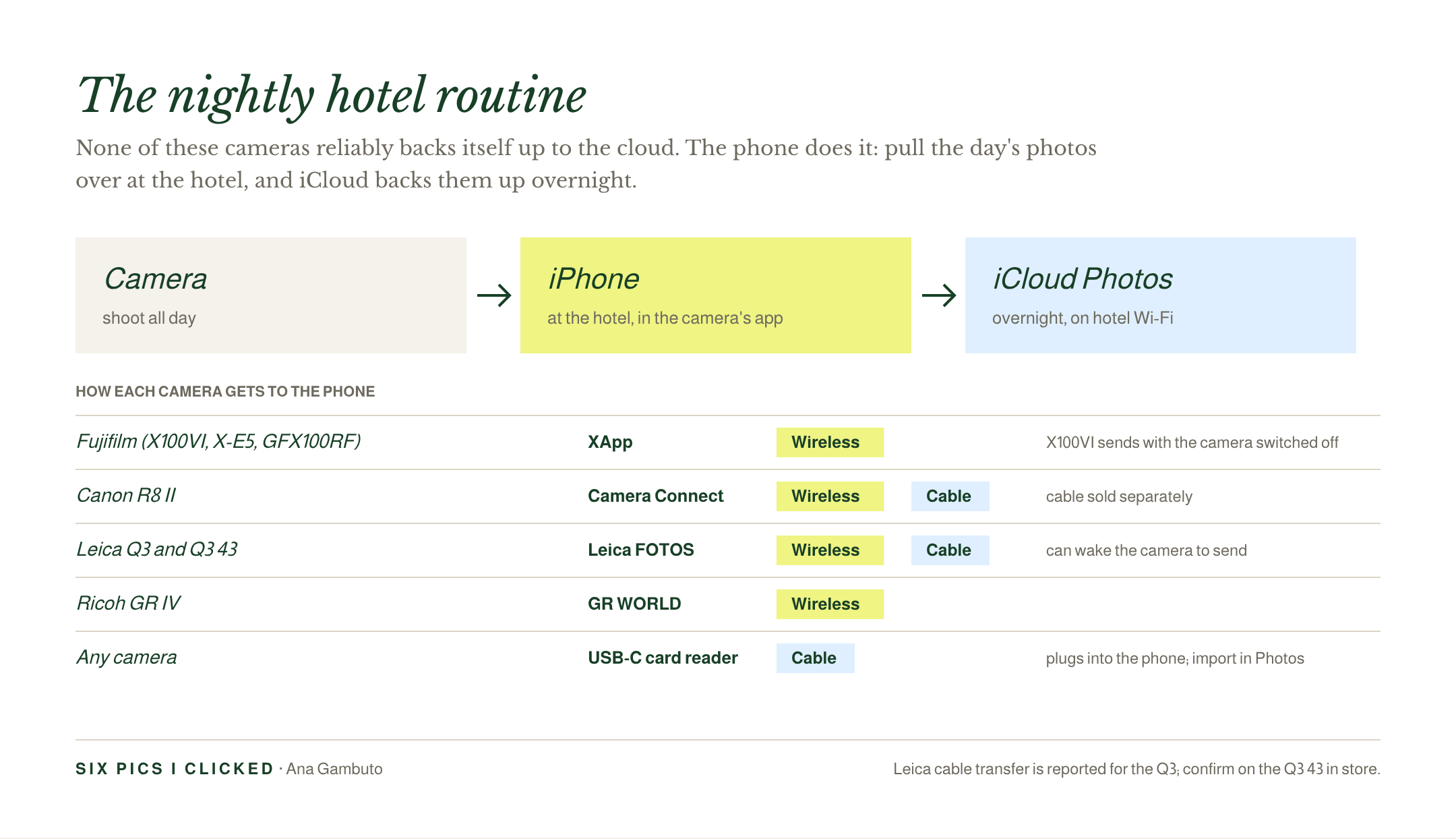
Getting photos home: every camera here sends photos to your phone. Do it at the hotel each night and then iCloud backs them up. You can also plug a USB drive like this one into your phone for a double backup if that makes you feel better!
The fourth problem isn’t gear. The photo in her head is more likely to appear when she gives herself time (even a few seconds!) to slow down and see the scene differently, as prompted through (literally!) a new lens. Constraints are king when you’re being creative because they force you to adapt. So a new camera = new eyeballs on the same life.
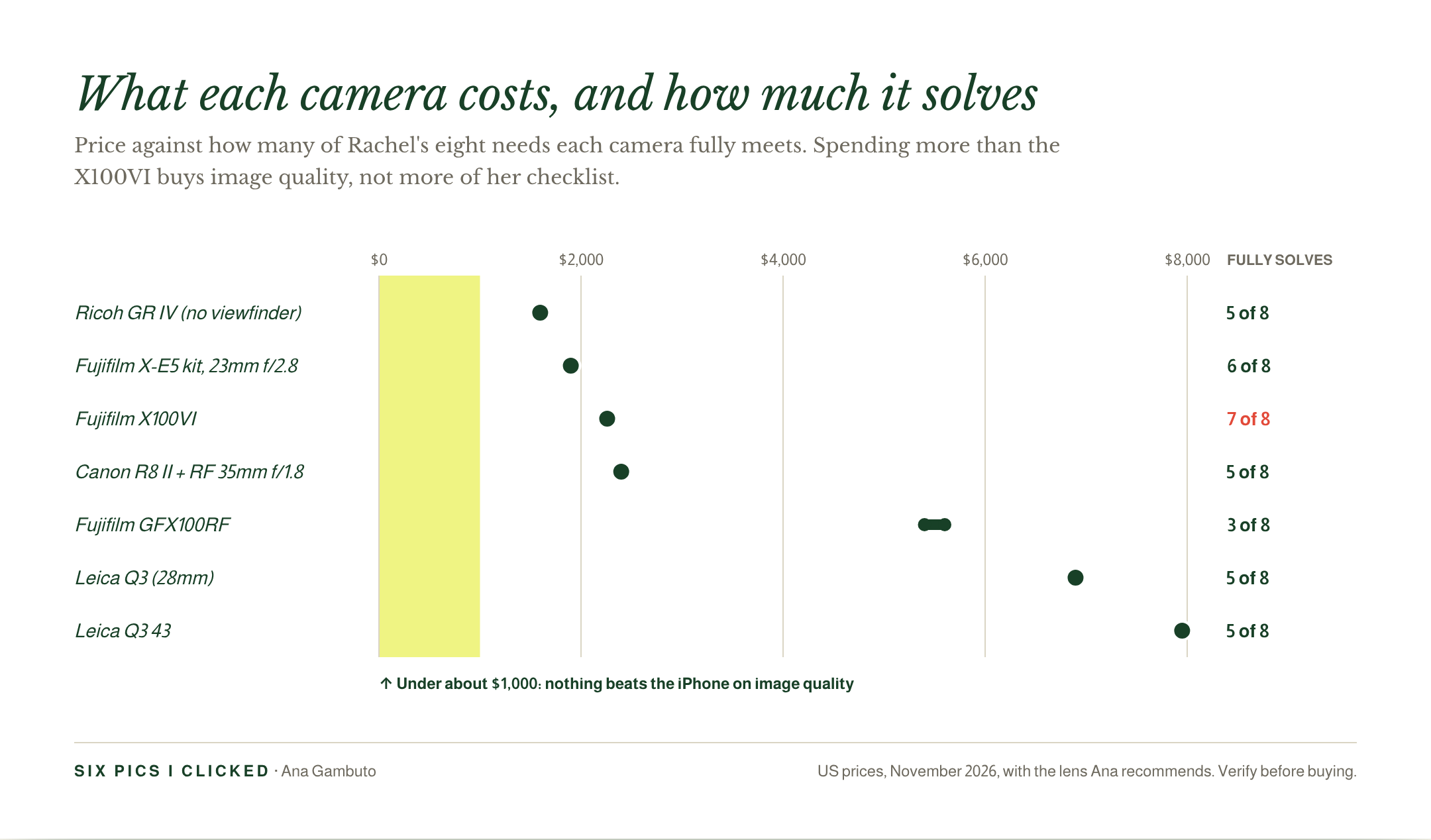
And I made charts!
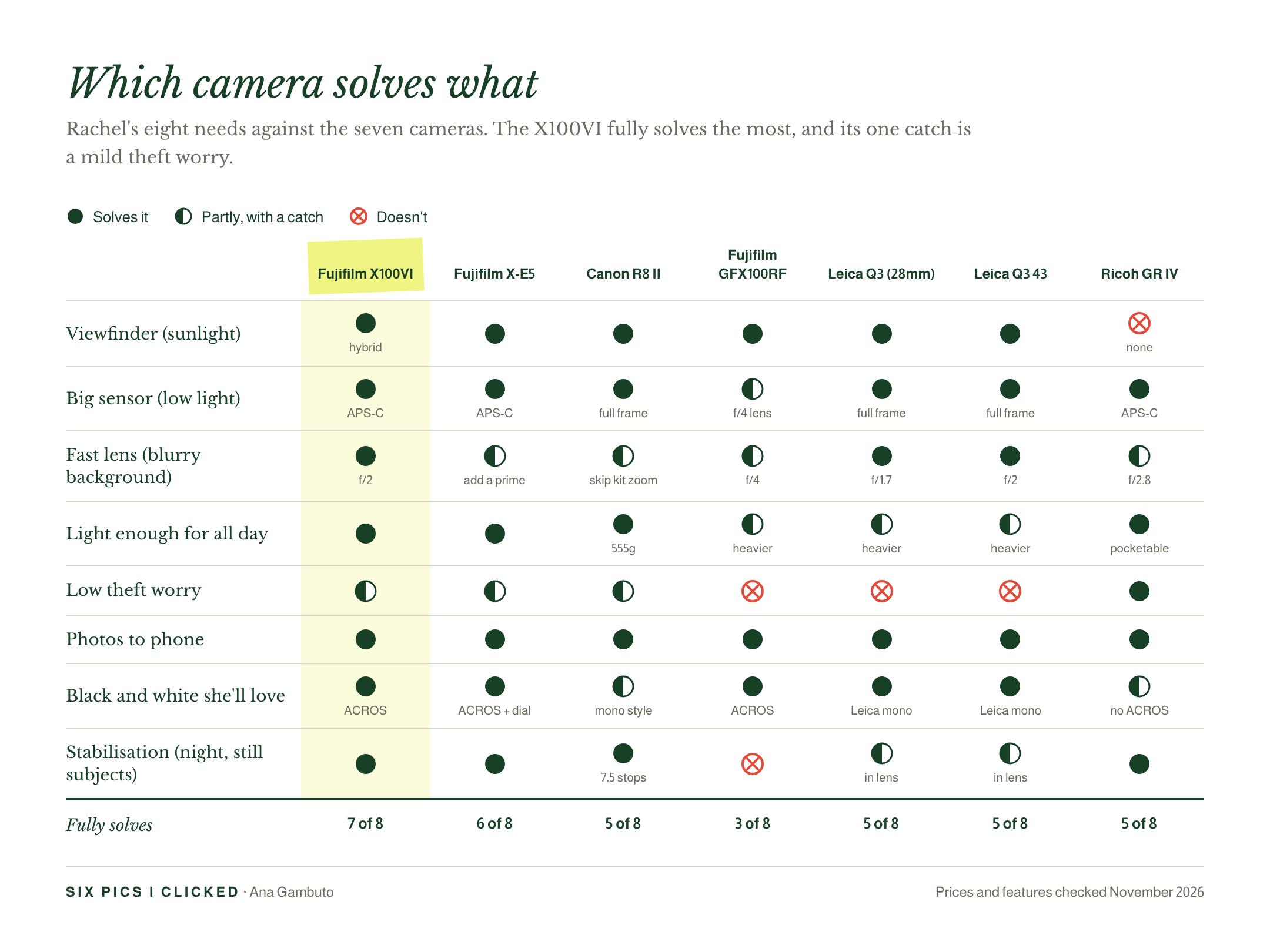
Scroll down for all those pain points Rachel mentioned, with the cameras that do and don’t solve each one. Find your issue, find your solution!
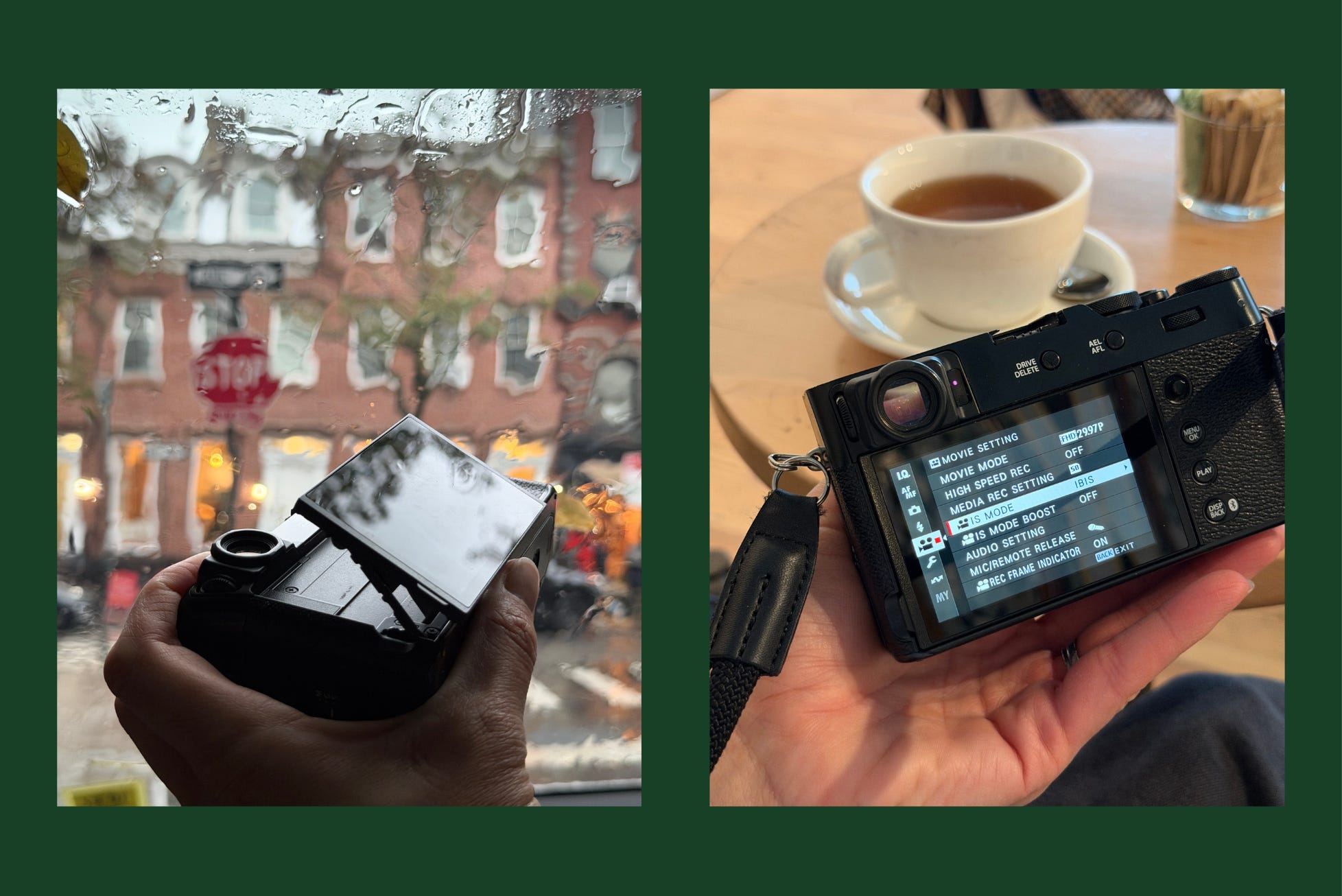
Is a camera better than an iPhone?
When I started researching, I wanted to keep the camera as inexpensive as possible, so the answer would apply not just to Rachel but to more of you. But the iPhone has gotten so good (I’m now shooting on the iPhone 18 Pro Max) that you have to spend quite a bit to get a better camera. The iPhone is expensive, and its camera is very good. So you won’t find a camera here under about $1,000, because there kind of isn’t one that beats the iPhone on image quality, and that’s what we’re after. Even older iPhone models (and many Android models!) are just, frankly, exceptional at getting you almost all the way there.
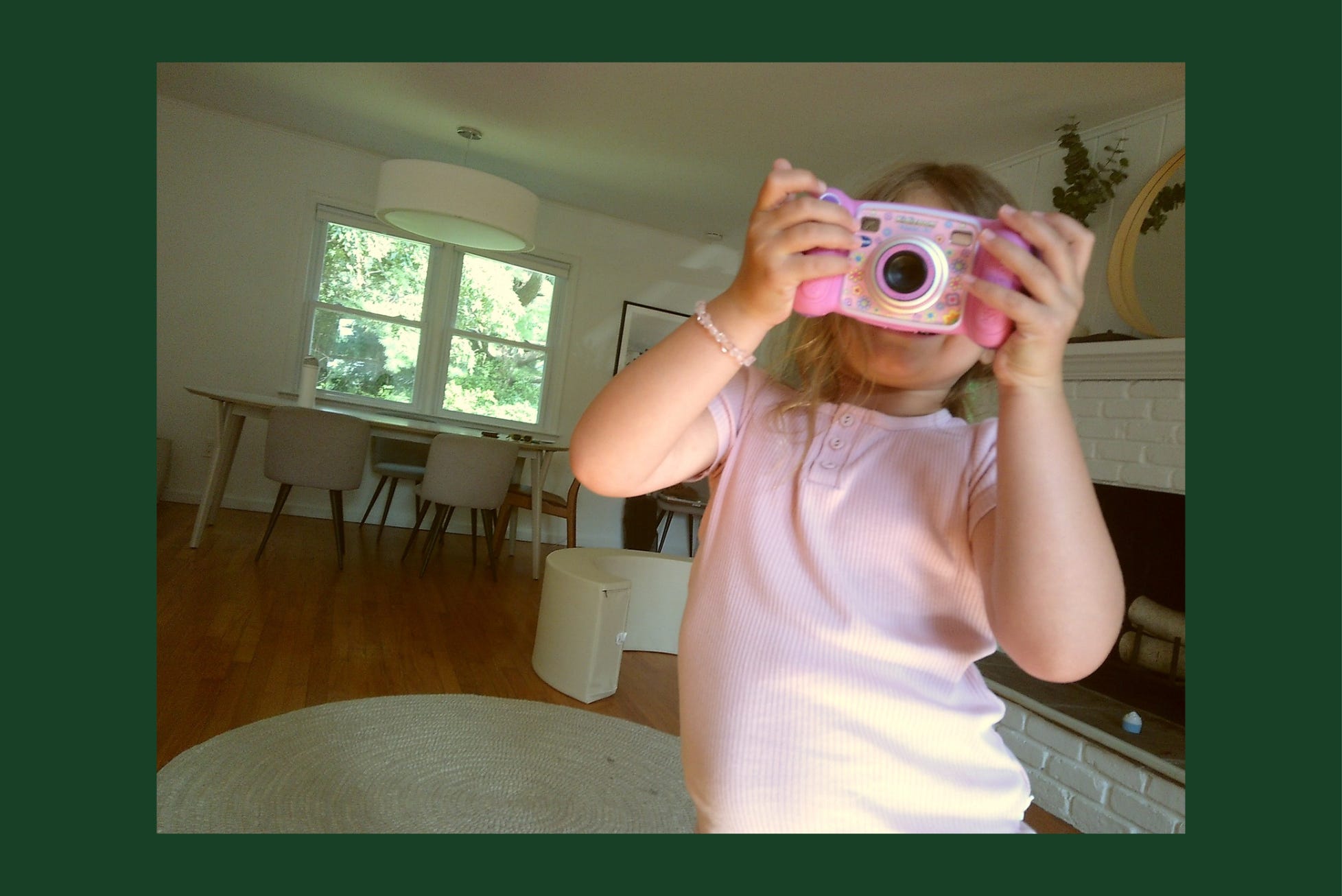
Budget pick: the Fujifilm X-T30 II, a discontinued but beloved retro-style Fujifilm, easy to find secondhand. About $1,050 to $1,300 with a fast prime lens. Gorgeous. (Here’s some photo examples I found, taken with the X-T30 II)
My creator pick, getting you an entry-level chance at a fun Fujifilm cutie: the Fujifilm X-M5. Great all-in-one creator camera (not for you, Rachel, because it has no viewfinder for shooting in that bright sun!), but it hits the $1k mark and is also excellent for video, if that’s your thing. (Here’s some photo examples taken with the X-M5)
True budget pick: the Camp Snap 2 ($69), a camera I authentically love and use myself and that my kids also use. There’s no screen at all, so you can’t check the shot; you just take it (there’s no lighter camera!) and download at night. You won’t be blowing up the resulting pics very big, but it’s fun and gives you a chance at the “slowing down and seeing differently” portion of this mission.
How to take the photo you see in your head
For Rachel, I’m focused on this line: “Frequently, I feel like the shot I am envisioning in my head just isn’t coming to fruition and it’s making me frustrated.”
Rachel still has the eye of a photographer. She can see the picture; she just has trouble making it. We’re going to find her the best tool to start making those photos again.
A camera fixes her first three problems. The photo she sees in her head isn’t a gear problem: this is where we talk about creating the time and permission to slow down enough to use her craft.
Rachel says, “I remember taking time to get a shot just right.” We’re going to do that, just quickly. Her family might be walking down the cobblestone road ahead of her, so she’ll practice with the new camera before her next trip, enough to take a little more time than she would have with her phone, but without falling behind.
A camera is a commitment: it’s heavier, it has one lens, and you have to decide to bring it, whip it out and press the button. That baby bit of friction is good. In the thoughtfulness those two extra seconds require, your art has room to rush back in.
How I tested
My process was to read everything on the internet about all of these models. I’m not kidding, I went deep.
Then, I spoke to four camera professionals at shops I’ve been going to for years; special shout-out to Manny at FotoCare on 22nd Street. Go there in person and hold these cameras! Or call FotoCare (you can do it, guys, make a real phone call!) and chat about your photo questions, old-school style. They’re true experts. I’ve been buying all my cameras there for 15 years, for good reason. This isn’t a collab, just a heartfelt recc!
Holding the cameras in real life helped me a lot. I used them in the store, checked the autofocus, analyzed the bokeh, checked the color, tested whether the menus were easy to use, asked about the sensors, and checked how flashy the cameras looked.
I really considered what it would be like to live with each one. Also, not to be overlooked, were they stylish? Were they too heavy on my neck? You have to be IRL to get these stats for yourself.
The best travel cameras in 2026, compared
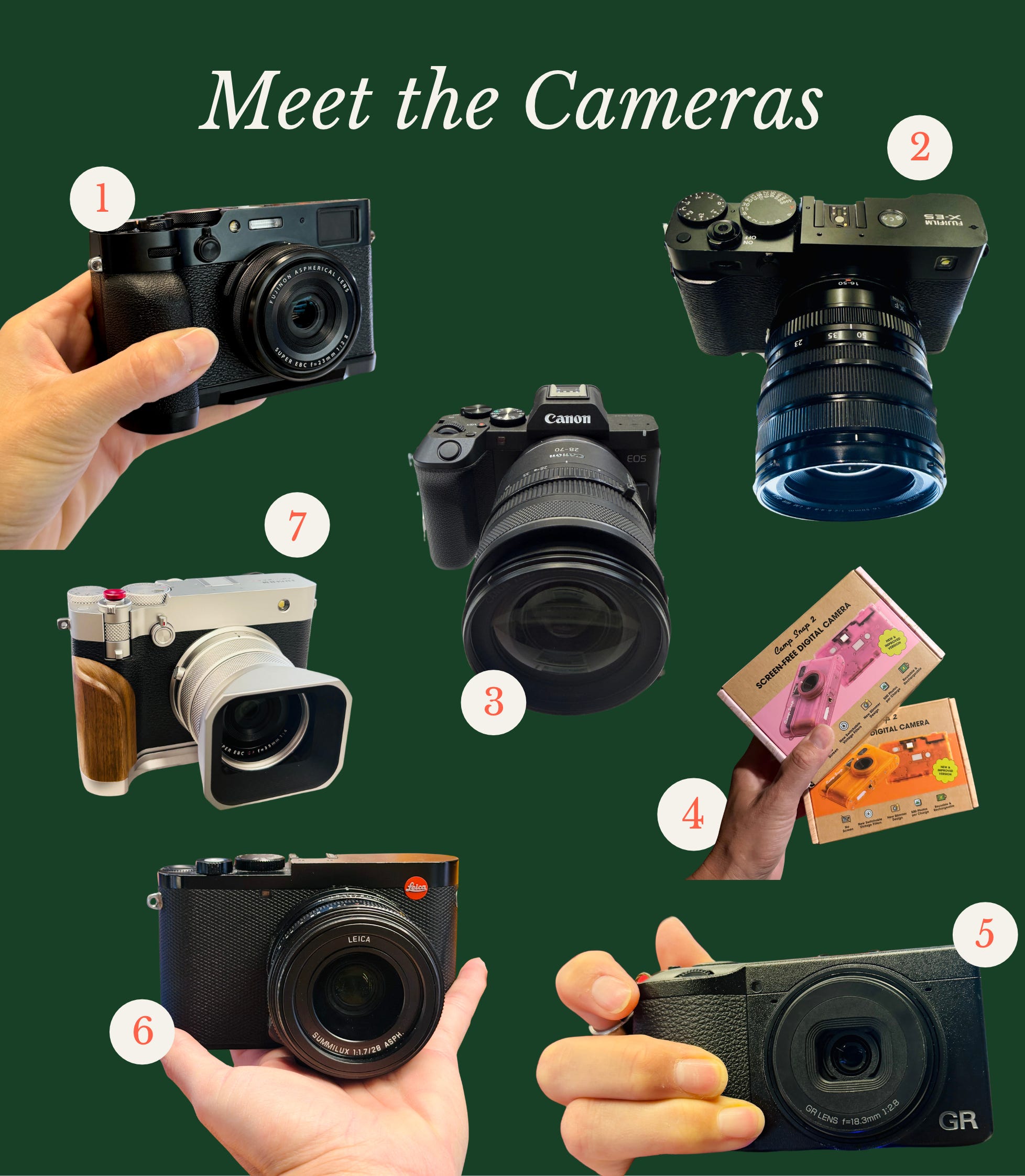
Below is the chart. The models we’re considering for Rachel:
the Fujifilm X100VI
the Fujifilm X-E5 (this camera and the X100VI are sisters: similar, with a couple of caveats)
the Canon EOS R8 Mark II
Luxe pick 1: the Fujifilm GFX100RF
Luxe pick 2: the Leica Q3, two versions (and an honorable mention for a third black and white version!)
How to back up camera photos while traveling
Every camera on the list can send photos to your phone. Rachel’s new routine: back at the hotel each night, she’ll open her camera’s app and pull the day’s photos onto her phone. Then her phone backs them up to the cloud.
The immediate standout: Fujifilm X100VI review for travel
Fujifilm X100VI camera with built-in 23mm f/2., $2,259
Note: Since I started this project, the price of this camera has jumped around, probably since it’s so in demand. Currently linking to vendors who still have it in stock!
When I picked this camera up, I aimed it at a plastic pamphlet holder in a harshly lit camera store, and the photo was gorgeous. This camera does no wrong.
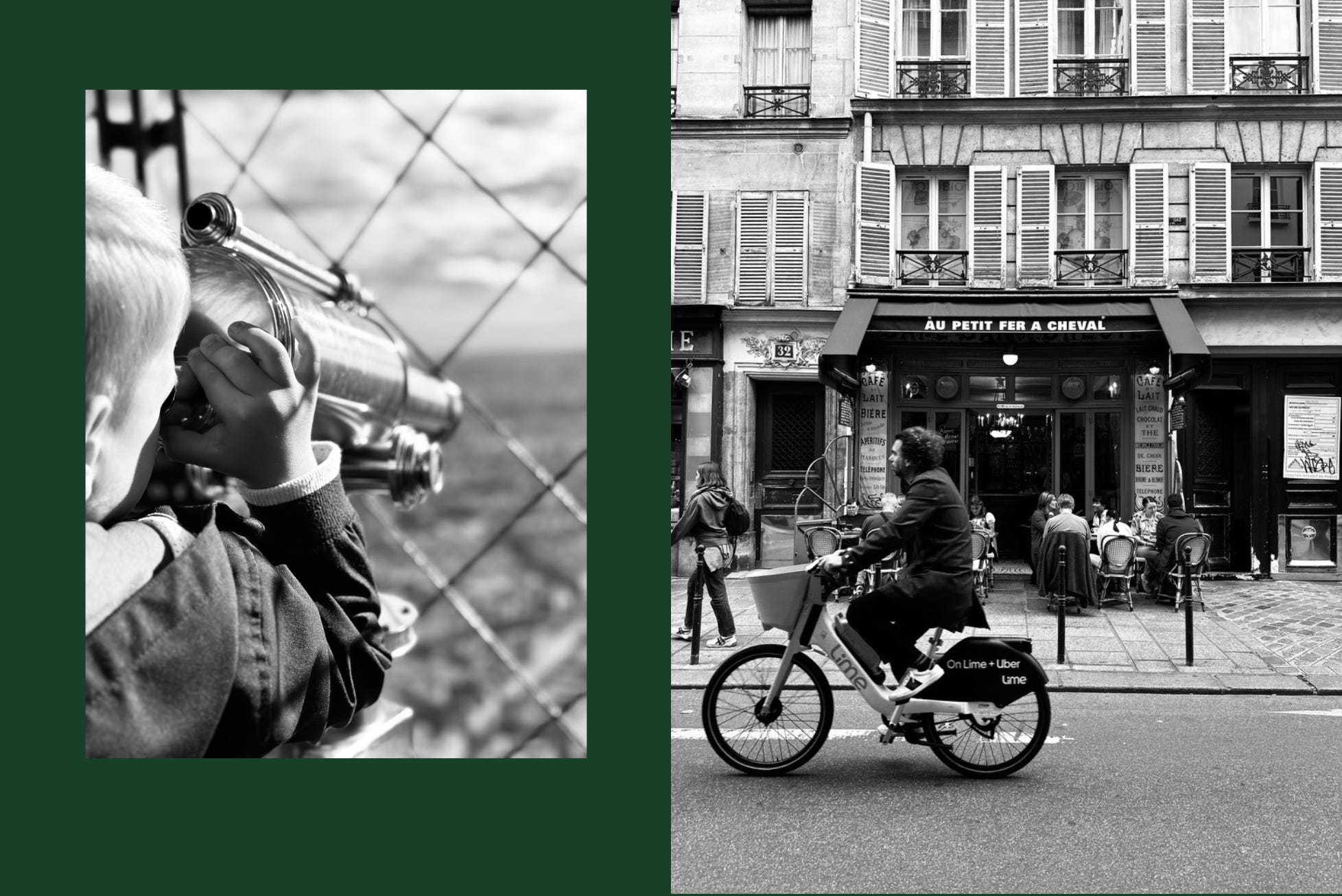
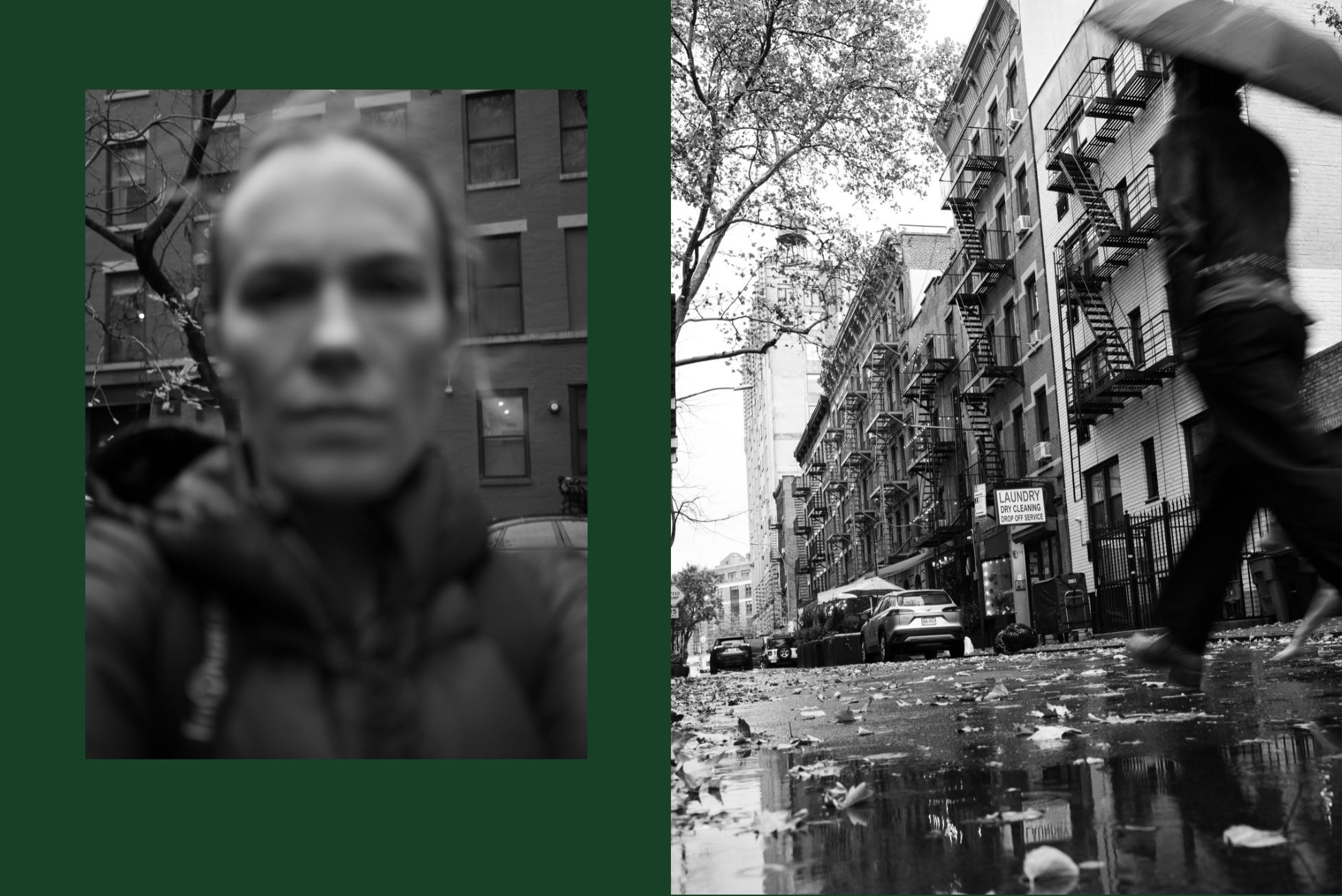
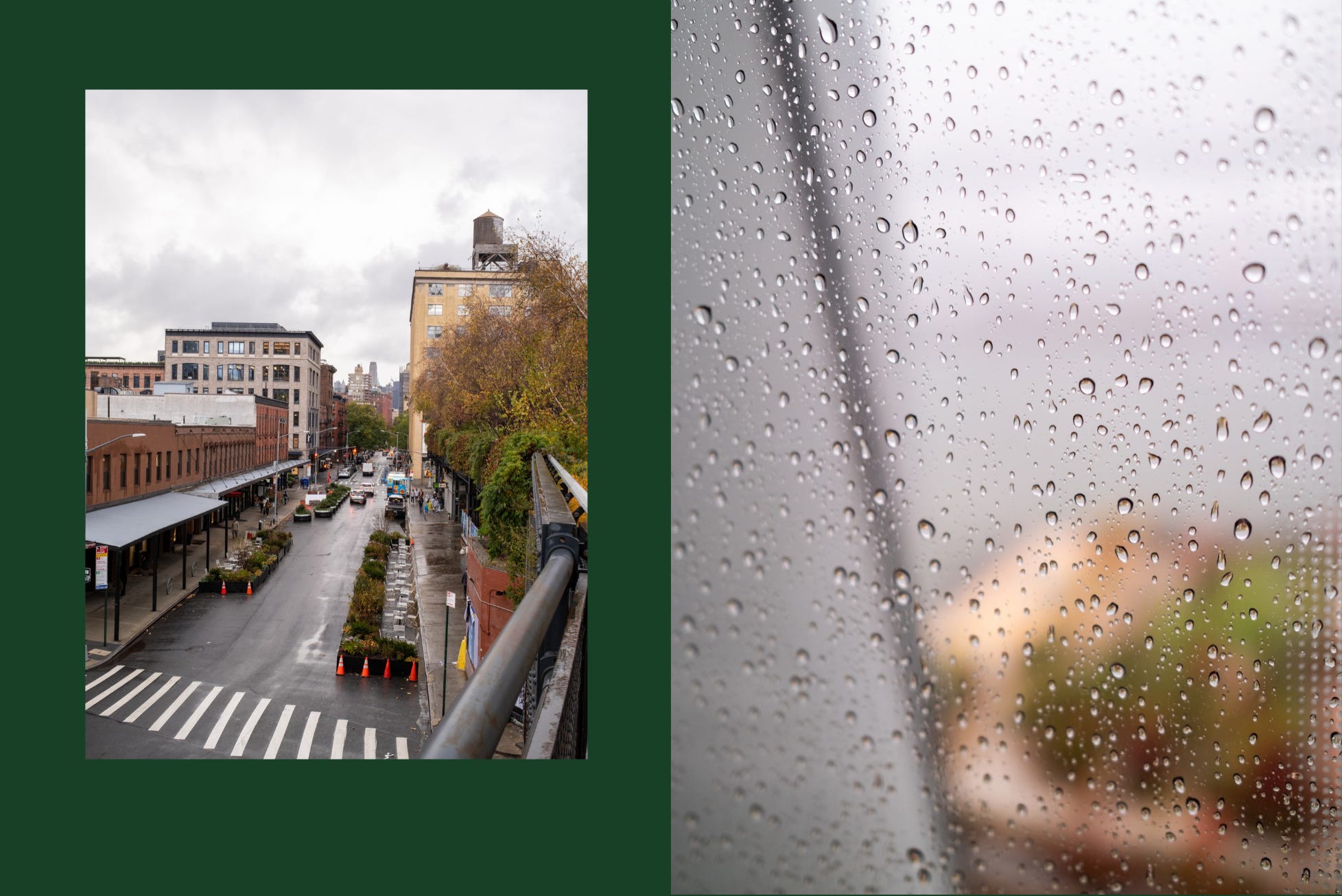
I’m not the only one who thinks so. It’s been backordered for weeks at most shops. Professional photographers who carry it on the side and civilian photographers alike love this thing. I’d heard the hype, and now I completely get it. I rented it for a rainy afternoon, and there’s some photos below.
It’s $2,259, and as you can see in the chart, it nails everything. (I also like this SmallRig thumb grip and shutter button add-on, under $20. It lets your big dumb fingers find the shutter easily, without looking. I saw it for the first time at the FotoCare counter and it’s the best thing ever that I didn’t know I needed!)
Fujifilm’s color is very nice, and the file size is plenty. And the fixed lens has real advantages when you’re traveling somewhere frankly dirty, full of actual dirt. If I’m in a market in Morocco changing lenses, I’m going to get dust on my sensor. That won’t happen on the X100VI. A strong travel photography pick.
What’s cool about it: a hybrid viewfinder that switches between an optical window and a screen, plus Fujifilm’s ACROS black-and-white feature (all you need to know is that it emulates a renowned Fujifilm film look from the past), which you can see live through the viewfinder as you compose. And, for those inclined, you can make your own “recipes” for film-simulation looks you like, with the effects of red and yellow filters, like the filters we used IRL in the aughts. At the end, I give a link to explore this idea more.
And, it’s the only one with a built-in flash! BEST FOR: the traveler who wants one camera that does everything, with no lens decisions to make.

The close second: Fujifilm X-E5 vs. the X100VI
X-E5 kit with 23mm f/2.8 lens: $1,899.
Note: The X-E5 is now the better-priced of the twin Fujifilms!
She’s super similar to the Fujifilm X100VI. The difference is she lets you change lenses. It’s a strong pick for someone who says, nope, I need to do different kinds of photos with this little thing: a portrait, a wide angle, all of it, on my terms. I liked holding this camera just as much as the X100VI. Both feel so light.
I love the idea of future projects being within reach. If you get into macro photography or food, or anything else, you’d be able to invest in the appropriate lenses in the future with this pick! Sigma makes incredible-quality lenses for this body, too.
I’d go with the Sigma 17-40mm f/1.8 DC, which looks gorgeous in samples online.
For me, the iPhone does a good job with wide-angle. Unless I’m planning to blow a photo up 50 by 60 on my wall, I’m happy to have my camera fixed with a portrait-type lens, and when I need a wide angle, I use my phone, because of course I’ll always have my phone too. But that’s easy for me to say, knowing that if I really wanted to change lenses, I have my pro camera kit in the wings!
What’s cool about it: physical dials, including a film simulation dial on top, with a little window that shows your chosen look even when the camera is off. BEST FOR: the photographer who wants room to grow into portrait and wide-angle lenses.
The technical one: Canon EOS R8 Mark II for low light
Canon EOS R8 Mark II with the 35mm/f1.8 lens I’d use myself: $2,398
My pro kit is Canon, the R5 Mark II, and I’ve been a Canon loyalist since I was a teenager using a Canon AE-1. Canon is quality with a capital Q and has really easy-to-figure-out menus and controls. Great for someone worried their technical fluency issues will ruin the adoption of this new habit, or who already loves a shiny new Canon and is embracing that brand loyalty.
What’s cool about it: a full-frame sensor in a 555g body, with 7.5 stops of in-body stabilization for sharp handheld shots in low light. BEST FOR: Canon fans, night streets, dim interiors and lit windows, for someone who cares more about low light than about Fujifilm’s black and white. Pair it with the RF 35mm f/1.8, not the kit zoom, to start. Expansion with infinite other lenses is also possible!
For landscape shooters: Fujifilm GFX100RF
Landscape photographers should go for the big camera. The GFX100RF is a beautiful beast. I really liked holding it. It has a unique retro look and feels serious, but somehow isn’t heavy. Are you hoping to go to Venice and shoot a body of work that may be featured mural-size in a gallery? The GFX100RF is your gal.
It’s medium format, but digital. If you’re a landscape shooter who wants to go to the heather fields of Ireland at sunset and get a massive print made, or who wants to shoot work for reproduction or sale, you should have this camera. It can shoot billboards with gorgeous texture and detail, with plenty of room to crop in. Insane.
For most things, for most people, you don’t need it. It’s expensive, bigger, and heavier than the other models tested here, and it doesn’t stabilize itself like some smaller cameras. It answers the depth-of-field and detail complaints, but not the night one. Rachel needs a low-light winner, and I’m mostly chasing small children, so it doesn’t make sense for me either.
But for another type of artist, it’s fantastic!
What’s cool about it: a 102MP medium-format sensor in a fixed-lens compact, plus a dial on top to change the frame’s shape. BEST FOR: the landscape shooter who prints big and shoots mostly in daylight.
The cult favorite: Leica Q3 vs. Q3 43
One more luxe pick: The influencer darling, the professional photographer darling, and the traditional photography enthusiast darling: Leica Q.
Leica is known for its “glass,” as we photographers say, and a Leica photo is going to be truly excellent quality thanks to that glass. Genuine fact.
Leica makes a small fixed-lens travel camera called the Q3. The Q line is, well, very expensive. The photos are very sharp. Like, if you nail the focus perfectly, you actually time travel into the center of the subject's eyeball.
The photos have delicious color, and a look and feel that’s very film-like. Paging nostalgic millennials!
The camera is easy to use and learn. I’d say it has an earned cult following. While I can almost guarantee you’ll enjoy it if you go for this guy, a Leica isn’t necessary for success in our artistic mission today.
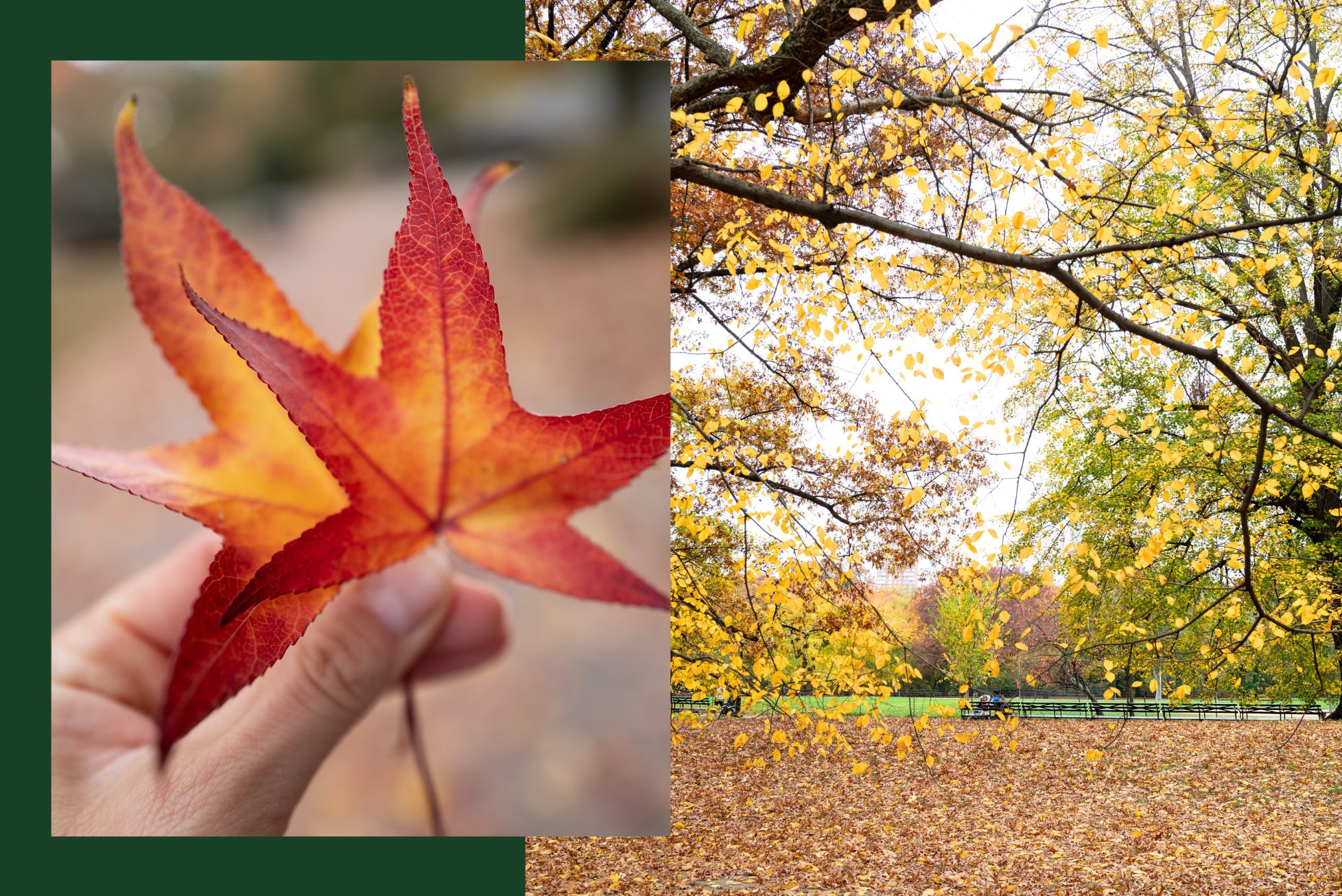
I rented one and used it; below are some of my photos. I rented the Leica Q2, the older model, which is a great way around the high Q3 price tag if you can find one used. If you’re in NYC, you can rent the Q2 at FotoCare to try it out.

But holding a Q definitely doesn’t solve the worry about theft. Leica, with its signature red dot, is expensive, and if someone spots you across the market, you’re a potential target. People often put stickers, labels, or black Artist’s tape over the brand name when they travel somewhere high-risk.
Note: there are three Leica Q3 models: the 28mm version (the focal length of the built-in lens on the Q2 that I tested, and you see here) and the Q3 43, which is slightly less wide and better for photographing people. I’d buy that one for me, to document daily family life. The Q3 43’s 43mm lens sees roughly what your eye sees. The Monochrom is the third, and it shoots in black-and-white ONLY with a special sensor! More on monochrome options below. If you’re set on the Q3 but aren’t sure whether the 28 or 43 is right for you, this article helped me.
What’s cool about it: Leica glass gives a rich, crisp, cinematic, and film-like look straight out of the camera. BEST FOR: the photographer buying the last camera they’ll ever need, who misses the look of film, and takes a lot of portraits.
Bonus: the best black-and-white cameras
Since we’re talking about bringing back the past, a few of you may have loved black-and-white film back in the day. I learned photography by developing film in a canister in my bathroom in Santa Barbara in 2001 when I went to Brooks Institute of Photography.
If black and white is the part of photography you miss, two excellent cameras skip color entirely. Their sensors have no color filter at all, so every photo comes out black and white, straight from the camera. The Ricoh GR IV Monochrome ($2,196) is the pocketable one, with a built-in red filter you switch on to darken blue skies, the way a screw-on red filter did on film. Like the regular GR IV, it has no viewfinder.
The Leica Q3 Monochrom is the luxe one: about $7,950 new, but used ones do turn up; I saw one last week at FotoCare for $5k ish. The catch with both: there’s never a color version of any photo. For Rachel, who loves color and texture too, that’s a big ask.
Bonus: the Ricoh GR IV, the best pocket camera
The Ricoh GR IV, $1,596
The Ricoh GR IV Monochrome, $2,196
I found it through a social media trend. I kept watching professional photographer creators pull Ricoh GR IVs out of their pockets, and I thought, what is that little thing? It looked so fun, it’s so small, and I wanted to check it out.
Scroll down for some inspo from this camera.
It doesn’t have a viewfinder, so it isn’t really right for Rachel, but it shoots a big, beautiful file, and it’s worth a mention for street shooters and people who want to always have it in their bag or pocket (vs. around their neck!).
What’s cool about it: a real APS-C sensor in a camera that truly fits in a pocket. BEST FOR: the always-with-you street shooter who’s happy composing on the screen.
My ultimate take: the best travel camera for Rachel
My recommendation for Rachel is the Fujifilm X100VI. This thing is a princess. She’s perfect, and she twirls laps around the other cameras when it comes to fixing Rachel’s pain points. Ditto, basically, for the X-E5, for my lens-changers!
Honestly, part of me loved all of the models we discussed here. If any of these pain points resonate with you, rank them, then choose the camera that best solves the problem that bothers you most.
If this piece prompts a question, ask it here!

Camera bags that don’t look like camera bags
I’m a big advocate of wearing these light cameras on your body at all times if you can, but of course, especially if you’re a mom schlepping kids and bags of stuff, you can’t.
Here are some places to put away your pixel baby so you can hold your human baby.
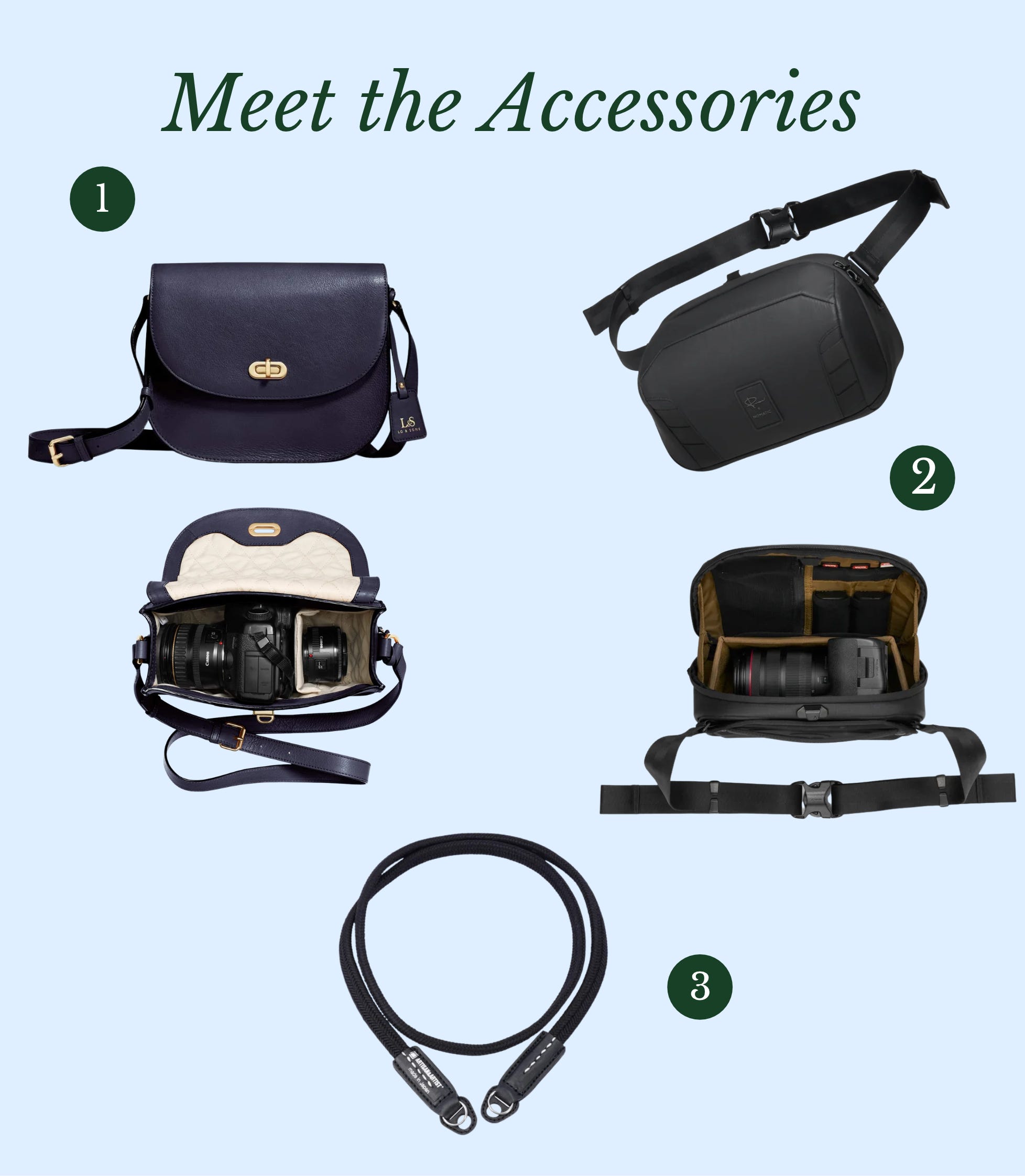
This Lo & Sons Claremont Camera Bag looks like a purse, for real! This company was one of the first to do this stylish camera bag thing, and I’ve loved several of their bags over the years. This size would be great for any camera in this post.
The Nomatic McKinnon Camera Sling 5L bag stopped me mid-stride in B&H. It’s pretty chic-looking, is made from resilient, strong fabric, and is lighter weight than leather. This is the size for the cameras mentioned in the post, and it’s great for travel since you don’t want to add extra weight. Works well on a daily mom schlep, too.
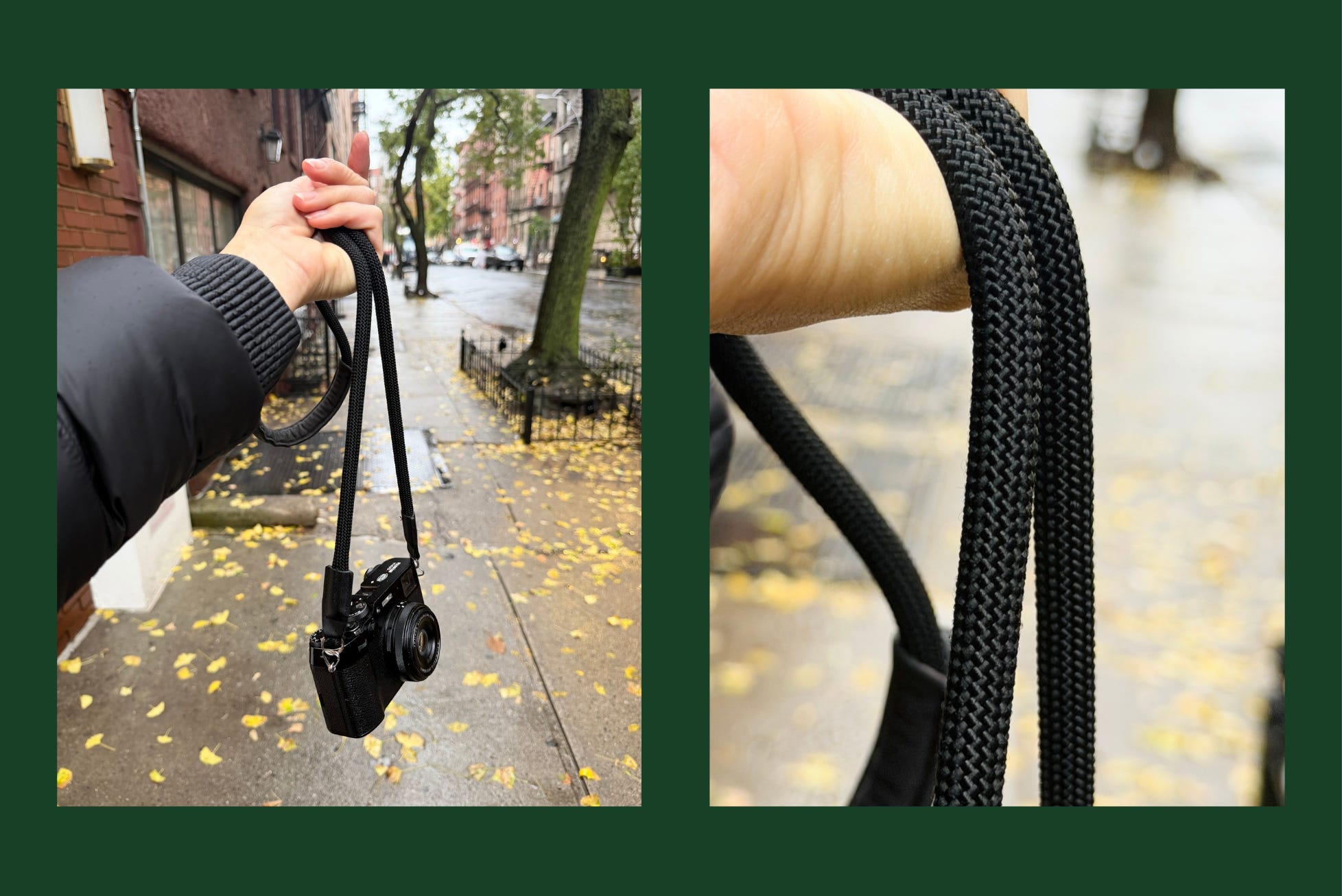
This Artisan & Artist silk cord camera strap was on the Fujifilm I tested, and I loved it! It’s easy on the neck, fashionable, and has no ridiculous brand text on it anywhere. Did not irritate my skin or catch on clothes during a very long walkabout.
Reviews and sample photos to dive into
Fujifilm X100VI how-to I liked, if you’re setting your new one up! I watched this when I started my rental day with it.
Fujifilm X-E5: A great walk-through of the X-E5, I loved seeing the normal daily moments here, it’s his daughter on a horse. “There’s something about photographing familiar, slower-paced moments that gives you a better sense of a camera’s ability. You’re not rushing. You’re just observing. And this camera really suits that.”
GFX100RF review from a landscape photographer, helpful overview.
Ricoh GR IV normal and Monochrome: Samuel Lintaro is a street photographer and Ricoh GR ambassador, and his channel is a fascinating look at why this pocket camera has such a cult following with street shooters.
Leica Q3: Nina Davidson is a Leica featured photographer, and one who’s right up my aesthetic alley, using her Q3 to document her babies at home. This camera shines with its big ol’ sensor in low light, which is valuable in the home.
Leica Q3 43: For a feel of what this camera does with everyday life, start with Alex Harrison Magrath’s Instagram. He’s a London lifestyle photographer, and Leica die-hard, and he’s another one of their featured photographers.
Leica Q3 Monochrom: For those ready to truly lock in on the idea of full-time B&W, this deep-dive review is for you.
Canon EOS R8 Mark II: Christopher Malcolm, an LA lifestyle and advertising photographer who shoots for brands like Nike and lululemon, took the R8 Mark II through the newly reopened LACMA. It’s a great look at how it handles dim museum interiors, exactly where Rachel spends her travel days. Concise, helpful review without jargon. I’m sold.
Fujifilm’s ACROS black-and-white film simulation: how it works, from Fujifilm itself.

What started as a quick search to help a friend turned into a deep dive on tech, habits, and what we’re all doing here, flying through space on a spinning rock. For me, it’s about finding a way to keep snapping that my kids will actually tolerate. I don’t have to tell you that time is a thief; you already feel it.
Maybe it’s midlife mortality fears popping up like whack-a-mole as I go through my day. Maybe. But every photo habit and hack I have exists for one reason: so I can feel these minutes and days again, later. So use these tools not just as a new toy, but to make a record of you and your life as it is now.
If this made your heart a little happier, forward it to a friend, or subscribe below.
hugs!!
Ana
As a mom who used to love photography and has only used my phone since I gave birth, this was sooooo helpful. Thank you.
this is SO good. and not only bc it's a sparkler collab!
also gimme that camera :)